Bitcoin Transaction Fees: Understanding Congestion and Choosing a Fee
A Bitcoin transaction fee is influenced by the space a transaction uses and the demand for confirmation. The amount of bitcoin being sent is not enough to determine the fee. Understanding virtual size, fee rates and changing network conditions makes an estimator much easier to interpret.
Crypto AI Trend · 5 min read · Published
On this page
Fees Pay For Transaction Space
Bitcoin transactions can contain different numbers of inputs and outputs and use different constructions. A transfer involving many inputs can therefore use more space than a simpler transfer, even when the bitcoin amounts look similar. A wallet's transaction-size estimate is more relevant to the fee calculation than the headline value of the payment.
Fee rates are commonly expressed in satoshis per virtual byte, often shortened to sat/vB. Once the estimated virtual size and rate are known, the basic multiplication is straightforward. The difficulty is choosing an appropriate rate for changing conditions and understanding whether the size estimate matches the transaction that will actually be created.
For a hypothetical 140-vbyte transaction at 5 sat/vB, the estimated fee is 700 satoshis, or 0.000007 BTC. At 20 sat/vB, the same size produces an estimate of 2,800 satoshis. These examples are arithmetic illustrations; the rates are not presented as current network recommendations.
What Congestion Means
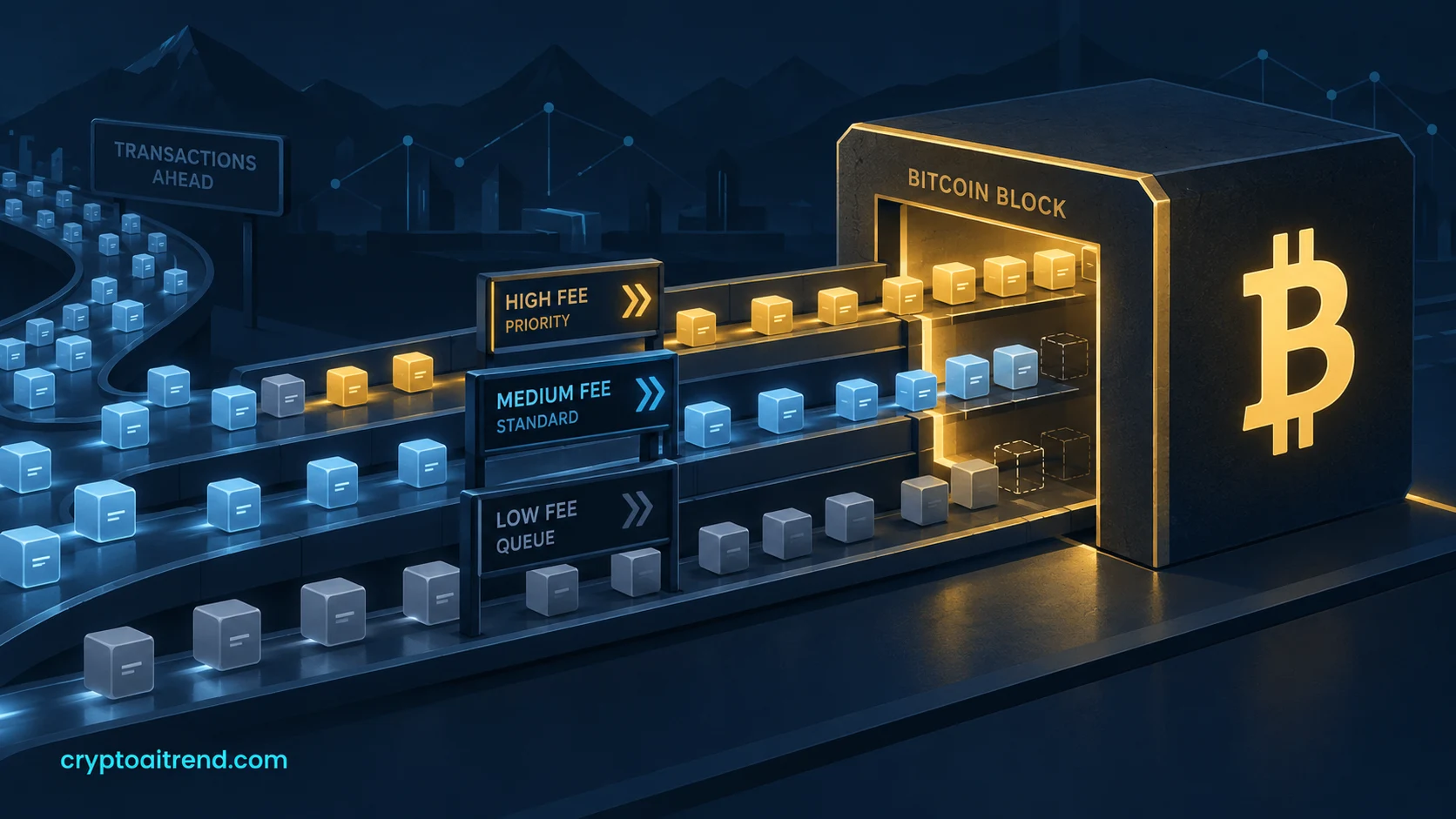
The mempool is a collection of transactions awaiting confirmation according to a node's view of the network. When demand for inclusion is high relative to available block space, fee competition can change. Conditions are not static, and different services may observe slightly different sets of transactions or use different estimation methods.
It is tempting to treat a fee recommendation as a guaranteed appointment for confirmation. That is too strong. A transaction's actual outcome depends on conditions after it is broadcast, the behavior of the transaction and the blocks subsequently produced. An estimate is useful evidence, but it cannot promise an exact time.
This is why the Crypto AI Trend estimator shows distinct priority estimates rather than a single universal correct fee. The available data helps illustrate trade-offs between cost and urgency. It does not send a transaction, choose a wallet setting on a user's behalf or guarantee that a particular transaction will be included in a particular block.
Read The Units Before Comparing Estimates
A fee displayed in BTC, a fee displayed in satoshis and a fee rate displayed in sat/vB are different quantities. Comparing them without accounting for units can create large mistakes. The complete calculation needs both the rate and the virtual size, followed by a clear conversion if the reader wants the total in BTC.
Two wallets can display different total fees while using the same rate because the transactions they construct have different sizes. Conversely, two services can estimate the same size but recommend different rates because they use different models or update times. Neither difference should automatically be interpreted as an error.
- Check whether the value is a total fee or a fee rate.
- Check whether transaction size is expressed in virtual bytes.
- Preserve the estimator's source and update time.
- Ask the wallet for its actual estimate before broadcasting.
Inputs And Outputs Affect The Result
Bitcoin's transaction structure includes references to spendable outputs and creates new outputs. A wallet might need to combine several available inputs to make a payment and create a change output as well as the recipient output. The result can be larger than a reader expects from looking only at the recipient amount.
That does not mean every payment uses the same number of inputs, nor that a single default size is valid for every script type. Our calculator's starting size is an editable example. A user with a wallet-provided size estimate should replace it with that estimate rather than treating the default as a universal description of Bitcoin transactions.
Understanding this structure also explains why a calculation can change after a wallet selects different inputs. The math is still rate multiplied by size; the transaction construction has changed one of those inputs. Keeping the size field visible makes that assumption explicit instead of hiding it inside a simplified amount-only calculator.
Why Sources And Freshness Matter
Our primary recommendation source is mempool.space, with Blockstream fee estimates as a fallback. Their outputs are estimates from separate services, not identical measurements with an obligation to agree. The interface identifies the provider and the last successful update so a reader can tell whether they are looking at recent information or a retained result.
If both services are unavailable, the page can still explain the arithmetic and show a clearly labelled cached result when one exists. It must not invent a live rate. A manual rate field allows a reader to calculate a fee using information obtained elsewhere while keeping the origin of that input transparent.
This approach is especially useful for an educational tool. A dependency outage should not prevent someone from understanding how a chosen rate affects the total. At the same time, continuing to show old data without a freshness label would create an inaccurate impression of current conditions.
Explore The Trade-Off Without A Price Forecast
Changing the rate from 5 to 10 sat/vB doubles the estimated fee for a fixed transaction size. Changing the size from 140 to 280 vbytes also doubles the estimate at a fixed rate. This simple sensitivity test helps a beginner identify which assumption is responsible for a large fee result.
It does not tell the reader where Bitcoin's price will move or how congestion will develop next. Network-cost research and market-price research answer different questions. A high fee environment can have several causes, and a fee chart by itself is not a complete description of investor demand or sentiment.
Use the fee estimator alongside your wallet's own information and the source documentation. Read the network guides if the size calculation is unfamiliar. The goal is to make the mechanics clear enough that the reader can recognize uncertainty and check the assumptions before acting.
Sources and Further Reading
Educational information. Examples and historical outcomes are not investment recommendations or guarantees.